The Power of Family Pilgrimage
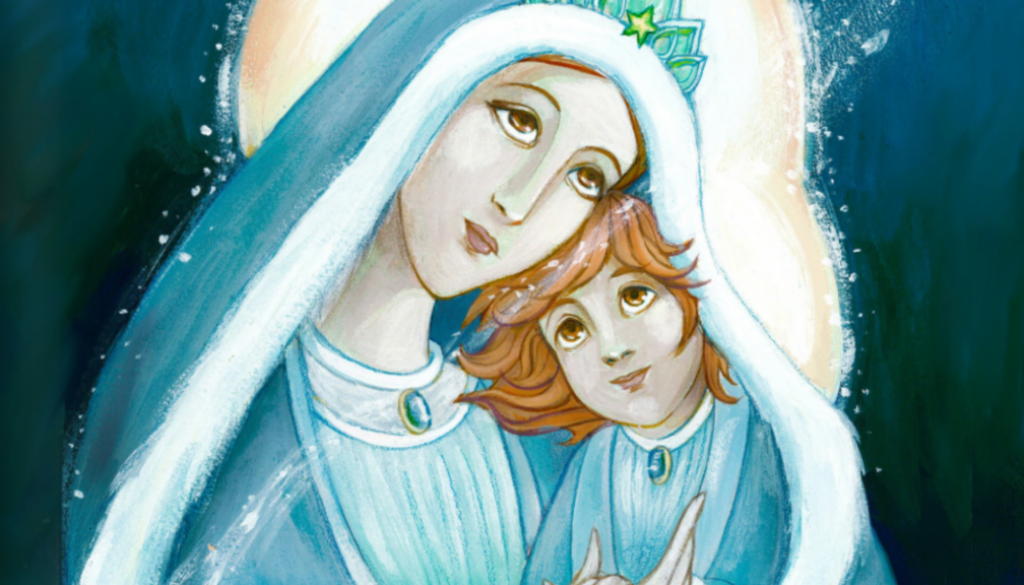
Our 2026 Full of Grace Youth Journal theme is “Marian Titles.” We celebrate Mary throughout the year by reflecting on the many names that honor her love, protection, and intercession. August’s themes are Our Lady of the Snows & the Queenship of Mary.
The Christian life is a journey. We are always moving homeward to Jesus. Through prayer and intention, we are looking to be changed by this journey, even if the change is known only to God.
For children, a pilgrimage makes this otherwise abstract idea physical and visible. By traveling to holy sites, we teach our children that faith is worth making an effort and sacrifice for. This month’s Marian title, Our Lady of the Snows, gives us a beautiful opportunity to introduce our children not only to the idea of pilgrimage, but to a very often misunderstood gift the Church draws from the treasury of Christ’s merits.
Who is Our Lady of the Snows?
According to tradition, in 4th-century Rome, a wealthy couple desired to give their riches in service to Mary and the Church. The Blessed Mother appeared to them and to the pope to tell them that a church should be built in her honor.
It was the middle of summer, hot and sunny, yet snow miraculously covered the crest of the hill where Our Lady was requesting the church be erected. The basilica built there became the Basilica of Saint Mary Major.
5000 miles away, pilgrims to the Shrine of Our Lady of Guadalupe in La Crosse, Wisconsin—of which the Youth Guild is an apostolate—share a very special connection to that ancient basilica. In 2011, the Shrine was officially affiliated with the Basilica of Saint Mary Major. Because of this affiliation, pilgrims to the Shrine have particular opportunities throughout the year to receive a plenary indulgence.
But what exactly is an indulgence? And how do we explain it to a child?
Forgiven and Healed
An indulgence is not the forgiveness of a sin. Forgiveness comes through repentance and, for serious sin, the Sacrament of Reconciliation. An indulgence is also not a way of “better earning” God’s forgiveness—our God is not a transactional God.
Instead, the Church defines an indulgence as the remission of the temporal punishment remaining because of sins whose guilt has already been forgiven. “Temporal punishment” is the debt that remains after a sin itself has been forgiven — the disordered attachment left behind, which must still be purified.
As Pope Saint John Paul II says, indulgences are, “the expression of the Church’s full confidence of being heard by the Father when—in view of Christ’s merits and, by his gift, those of Our Lady and the Saints—she asks him to mitigate or cancel the painful aspect of punishment by fostering its medicinal aspect through other channels of grace” (General Audience, 29 September 1999).
A plenary indulgence removes that temporal punishment in full, with “plenary” meaning full or complete.
For children, we can explain this with an example from ordinary life:
A child throws a toy and breaks his mother’s favorite vase. The child admits his mistake, apologizes, and receives his mother’s forgiveness. But forgiveness will never restore the vase to its prior state, and there are emotional consequences to the mistake for the mother that reverberate beyond the apology, and the act itself is telling of the child’s own heart.
In order to ensure that such a mistake does not happen again, the child has to change fundamental things about how he handles his anger. Undergoing this behavioral transformation will likely be uncomfortable and difficult, but worth it as he becomes more Christlike and loving toward his family and others. This transformation is a form of healing.
A plenary indulgence helps us understand this distinction between being forgiven and being healed of the residue sin leaves behind. The indulgence does not replace repentance or reconciliation. The indulgence remits the temporal punishment—the debt that remains after sin has been forgiven, which would otherwise be satisfied through purification in this life or in Purgatory. We are pointed toward the fullness of restoration God desires for us. He does not want to only pardon us. He wants for us that every attachment and wound caused by sin be healed. He wants our hearts conformed more completely to His.
God forgives generously, yet He also desires to heal and purify everything that sin has damaged. He desires our theosis, our being made divine by His grace, by Jesus’ saving work. His grace flows freely and is not dependent upon our performance. But when we show up and sacrifice in the face of God’s love, such as with a pilgrimage, we are responding to Him with our whole selves, which is pleasing to Him and life-giving for us.
Making a Pilgrimage with Children
A journey has a beginning and an end, with many adventures taking place along the way. Children likely recognize the story of a pilgrimage from their favorite books and movies, their own family vacations or trips to attend weddings, funerals, or reunions. When you begin a pilgrimage with your children, you can make it clear that this trip is different than all the others by setting an intention.
Would someone in your children’s life really benefit from prayer? Offer the pilgrimage for that person.
Has a loved one recently passed away?
Is your family experiencing a burden they would like to hand over to Our Lady? Discuss these intentions with your children and pray over them together.
Let your children be restless and tell them to pray for patience, offering their boredom or anxieties up to God. Help them see that prayer can be a part of every single aspect of their life’s journeys. Encourage them to show up with their whole selves for God’s love.
Receiving the Gift of a Plenary Indulgence
For pilgrims to the Shrine of Our Lady of Guadalupe, the indulgence associated with its affiliation with Saint Mary Major may be gained on August 5, December 12, the Marian solemnities of January 1, August 15, and December 8, once annually on a day freely chosen by the pilgrim, and when participating in certain organized pilgrimages to the Shrine.
The prescribed work includes…
- Visiting the Shrine Church and praying the Creed and an Our Father
- The usual conditions for a plenary indulgence:
- a sacramental Confession
- reception of Holy Communion
- prayer for the intentions of the Holy Father
- and complete detachment from sin, including venial sin
Depending on their age, children may not yet be capable of fulfilling all these conditions themselves. That does not make family pilgrimage less valuable. Before First Communion, a child can still see his parents go to Confession and receive the Eucharist with reverence. He can learn the Creed, pray for the Holy Father, and discover that as a Catholic, he is bound in prayer to the faithful around the world, whom he may visit, commune with, learn from, and pray among.
If you aren’t able to make it to La Crosse, WI, there are many other pilgrimages to take to receive the gift of a plenary indulgence, and a quick online search will help you find the right destination for your family.
A Family Learning to Travel Toward Heaven
We will not be able to decide every road our children take on their life’s journeys or prevent every wrong turn. But we can walk with them toward a holy place together, demonstrating that our entire lives are meant to be a movement toward holiness. God always provides a way home, and it might be a smooth journey, but it’s more likely to be an unexpected one, even one full of roadblocks and pitstops.
Mary seeks to join us on that journey, always leading us to her Son.
This August, tell your children the story of snow falling impossibly upon a Roman hill and about the church that rose there in honor of the Mother of God. Whether your family makes a pilgrimage to the Shrine or simply incorporates the idea of pilgrimage into their daily trials, teach your children that we are never without a destination. Jesus’ heart is always eager to welcome us in.
Our Lady of the Snows, pray for us!
Enjoying What You’re Reading?
If this content resonates with you, consider enrolling in the Youth Guild.
Receive the printed Full of Grace journal every month, mailed directly to your home to help your family grow in holiness — together, under the patronage of St. José Sánchez del Río.
Enroll Now