A Refuge at the Door of Mercy
Our 2026 Full of Grace Youth Journal theme is “Marian Titles.” We celebrate Mary throughout the year by reflecting on the many names that honor her love, protection, and intercession. July’s titles are Our Lady of Mount Carmel & Refuge of Sinners.
Every Rosary, apparition, and title borne by the Blessed Mother shares a common destination: our relationship with her Son.
As we contemplate this month’s two Marian titles—Our Lady of Mount Carmel and Refuge of Sinners—we are reminded of the courage it can require to go home to Him both in the confessional and at the altar. One requires the courage of honesty, naming our sins and making an act of contrition. The other requires the courage to humble ourselves and surrender to receive His love.
When we think back on our own childhoods, what was it like to tell the truth about something we’d done wrong? Do we have the experience of being embraced in our faults—not excused or minimized, but received as we are, and not made to see our failures as integral parts of our identity?
How can we teach our children that the longer we carry our sins and rehearse reasons to stay away from God, the greater the impact on our hearts and minds?
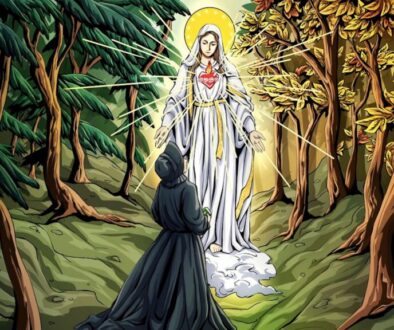
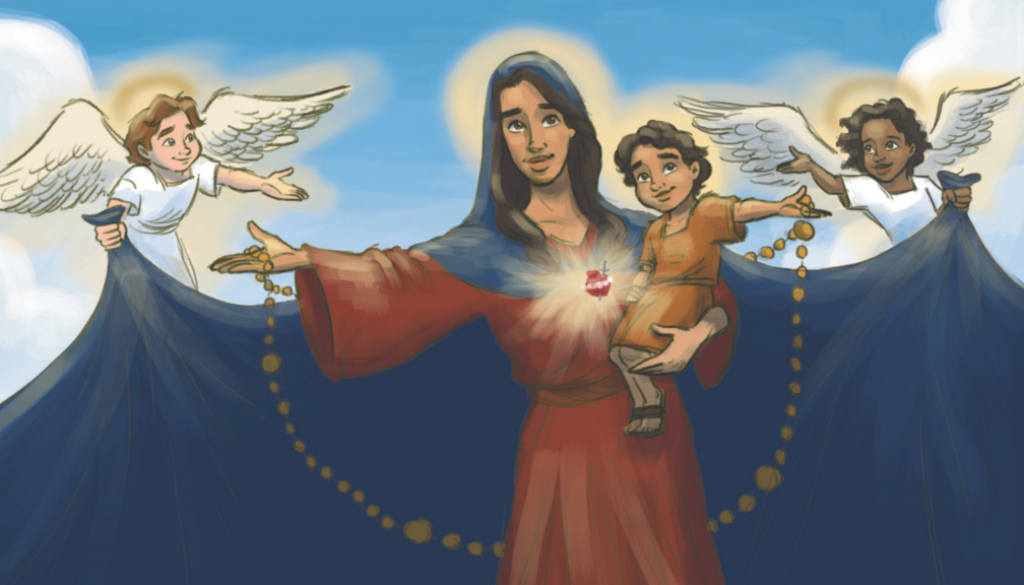
Mary is called Refuge of Sinners in the Litany of Loreto. This title does not soften the reality of sin but instead allows us to see past the idea of sin as a state one cannot escape and instead as something we can ask for help with. We can take cover beneath Mary’s mantle and, like a child, we can rest safely in her love as we make true efforts to grow. Mary gives us refuge not from the consequences of our sin but from our own shame that convinces us that God does not want us close. She longs to draw us back to Him—especially into the grace offered in the Sacrament of Reconciliation, where we are met with mercy that restores what sin has wounded. The focus on continual conversion found in the Carmelite tradition can help us as parents to guide our children to the confessional.
A Habit of Return
The Carmelite tradition began on Mount Carmel near Jerusalem, sometime after the Third Crusade. Lay hermits seeking silence and a life ordered entirely toward God found such a life on Mount Carmel, under Mary’s patronage. Emerging from this tradition, the Carmelite Order are a contemplative religious order who take vows of chastity, poverty, and obedience, with a deep devotion to Mary. A Carmelite spirituality is one of “staying before God” continually through prayer, silence, and meditation. In one way, this spirituality is ordered around continual return to the Lord—continual conversion, continual prayer, and continual purification in relationship with Jesus.
A refuge is a place we can turn to and return to in all times of need. The heart of the Carmelite spirituality pairs beautifully with Mary’s title as Refuge of Sinners because each honors Mary as the sheltering mother who gathers sinners into a life of continually returning home to Christ. As we consider the Sacrament of Reconciliation in the lives of our children, this emphasis on our faith as a safe home is paramount.
Many of us have fallen into the trap of imagining God as someone who will react the way we fear: by withdrawing from us like an angry, reactive parent. But part of the gift of the Sacrament of Reconciliation is that it undoes this false image of God. When we confess, we enter a place where sin is met by a mercy far greater than we can fathom.
Mary reminds us of that mercy and prepares us to receive it as she shelters us under her mantle. She does not look away or condemn us when we speak the truth of our actions. She trusts in God’s mercy and inspires that same trust in us. She reminds us that on the other side of our honesty and our pain is a love that is all-powerful and definitively peaceful. Keeping us safe and guiding our contrition, she puts wind in our sails toward Christ.
Saints Who Teach Our Children to Return to God
There are a number of Carmelite saints that we can learn about with our children to inspire them to participate in a spirit of continual return toward God through the Sacrament of Reconciliation.
St. Teresa of Ávila insisted on honesty before God, even in one’s frustrations. She knew that without honesty, there is no genuine closeness in a relationship. She reminds us to demand of ourselves not perfection but the authenticity required to find refuge in Mary, in Christ’s love, and in peace, rather than hiding in the shadow of our sins. While this shadow can feel protective, it is ultimately detrimental. Her radical honesty is an inspiration toward those of us who may avoid the confessional.
St. John of the Cross wrote of the “dark night of the soul,” in which God seems absent and the person is spiritually adrift, arid, or listless. He understood that a purifying power is at work in a life’s darkest moments, and that though we may feel distant from God in those times, he does not reject us. Instead, this purification removes that which keeps us from loving Him fully. When we avoid reconciliation, we avoid this purification, and our “dark night” may grow longer as a result.
St. Thérèse of Lisieux is the advocate for achieving holiness through the smallest of actions. It was not about “never failing” for St. Thérèse, but instead about returning to God after our failure by reorienting even our most minor seeming habits and behaviors toward Him. We must trust that He is always ready to forgive us and humble ourselves in the face of his Mercy.
St. Edith Stein’s journey to Carmel was built on surrender—of letting go of control, certainty, and safety. She offered her intellect and her identity to Christ, yielding her entire selfhood to His grace. Her Carmelite name is telling of this surrender: Teresa Benedicta of the Cross. Reconciliation requires a surrender like that we see in her life story.
Across their differences, the Carmelite saints converge in the idea that a spiritual life is one carried by a rhythm of returning, again and again, to the Good and True, no matter how far we must travel to get back there. On our journey, we may take cover under Mary as we pray for the intercession of these holy men and women.
For Parents Learning with Their Children
Children often learn from observing patterns, and they are best led by example. Gently consider the following questions:
Do you receive the sacrament of reconciliation regularly?
Do you encourage your children of age to do the same?
Are your children aware that your prayer life is active?
Do you prioritize it in front of them?
In your home, do you struggle to avoid shame when it comes to failure and mistakes?
Do you take that struggle to God in prayer?
Do you make it clear that your children may always return to you, modeling a Marian kind of love?
If not, what tangible steps can you take toward making this a reality? The Daily Examen offers a useful, faithful starting point.
We must make sure our children realize that holiness is not perfection, performed piety, or scrupulosity. It is the willingness to take responsibility, right the course, keep one’s sight on God, and believe in His mercy over our own shame. The goal is not to create a home without sin, which is impossible, but to create a home where love, protection, and forgiveness prevail over sin.
Assure your children today that Mary will never turn from them, and challenge yourself to be a steadfast refuge in their life.
You might just raise a group of people who are a refuge to others themselves. This is the kind of love that can shape the future. Not in the shadow of sin, but in the light of grace.
Our Lady of Mount Carmel, pray for us!
Enjoying What You’re Reading?
If this content resonates with you, consider enrolling in the Youth Guild.
Receive the printed Full of Grace journal every month, mailed directly to your home to help your family grow in holiness — together, under the patronage of St. José Sánchez del Río.
Enroll Now